Spinal surgery for a child is never a small decision. But when bracing can no longer slow the progression of a spinal deformity, spinal surgery can protect a child’s long-term health. Still, choosing the right approach can be challenging.
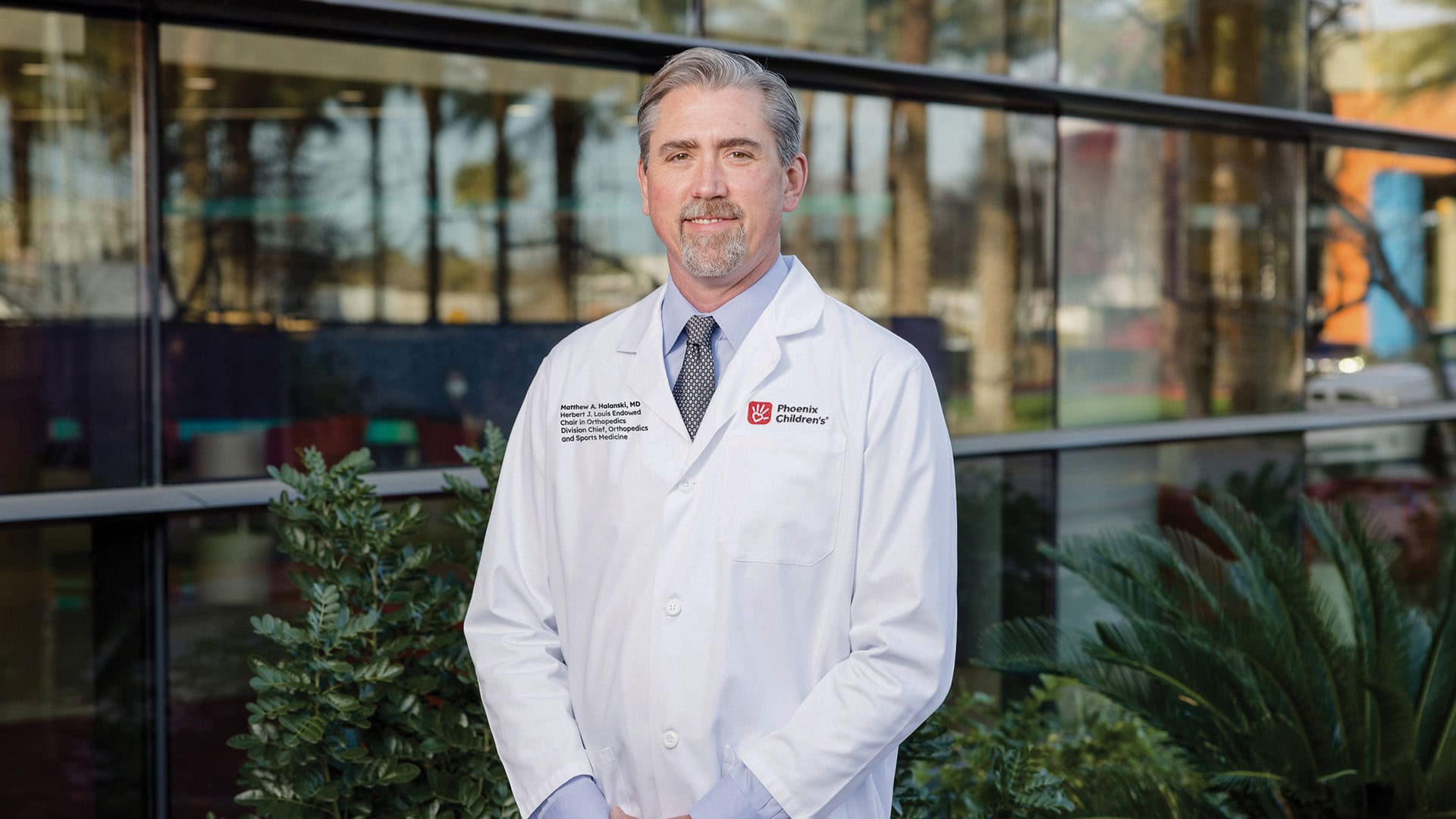
Matthew A. Halanski, MD, division chief of orthopedics and sports medicine and the Herbert J. Louis Endowed Chair in Orthopedics at Phoenix Children’s, recently received a prestigious R01 grant—a highly competitive, multiyear research award from the National Institutes of Health (NIH) that supports large-scale studies—to better understand how best to modulate a child’s spinal growth and preserve flexibility. The insights gained aim to improve surgical techniques and better predict which children will benefit most from specific procedures.
“Spinal deformity surgeries carry significant risks and are among the most expensive in orthopedics”, Dr. Halanski says. The most common procedure is spinal fusion, which uses rods and screws to straighten the spine and permanently fuse sections of it together, leading to restricted flexibility.
A newer alternative, vertebral body tethering (VBT), uses a flexible cord to modulate the remaining growth of the vertebrae to correct the deformity, allowing for increased motion. However, the procedure is relatively new and does not effectively work for many children.
Currently, the field is limited by gaps in understanding of how skeletal maturity and flexibility affect spinal growth. Thus, the ability to harness that growth to correct deformities has been limited. “We know that VBT works in some kids, but not in others,” he says. “I want to know why.” Understanding how skeletal maturity and curve flexibility affect growth will allow the development of a predictive model capable of identifying which patients will do best with which procedures given patient specific parameters.
This entire line of inquiry began over 10 years ago with an industry sponsored grant. That initial, philanthropic support generated data necessary in obtaining a previous NIH R21 award. The findings from that extramural award have recently been published and were crucial in securing the current $2.7 million R01 award.
As he begins work on this five-year study, Dr. Halanski is focused on his research program’s overall purpose: “To minimize morbidity and increase the safety of pediatric orthopedic procedures,” he says. “I hope that from this work, we find new, less-invasive approaches to correct spinal deformities and eliminate bad outcomes, ultimately leading to treatments that are easier on our patients and their families.”
Learn more about the Herbert J. Louis Center for Pediatric Orthopedics and Sports Medicine at Phoenix Children’s.
Your support makes it possible for Phoenix Children’s physicians, researchers and clinical leaders to turn their visionary ideas into reality.